

THE PERIPHERAL MAN
Chapter 1
Ifram Blest had sat in front of his home computer for a very long time. He wanted to start writing the thoughts that had been occupying his mind lately. But he was afraid. Outside it had begun to snow heavily. In spite of the weather conditions, he could see through his living room window that the flyers were out in large numbers. The sky was aglow with their bright multicoloured lights. They went by with great speed but soundlessly. People flying home from work. It was rush hour.
He very tentatively punched a key and the first letter appeared on the luminescent yet mat screen. He erased it quickly. Almost certain that what he wrote would immediately be known by the bureaucrats at the Office for the Control of Systemic Irregularities, he was about to turn off the computer. But a sudden impulse he knew was probably suicidal made his hand move rapidly over the keyboard. The first sentence appeared on the screen. It contained one single, silly question:
“What makes the writing of Jack Kerouac dangerous to read?”
His next impulse was to erase the sentence. But it was too late. The computer screen went a dreadful crimson and it remained frozen regardless of what combination of keys he pressed. He shuddered with fear, realizing that he had been discovered. It was a crime to express any thing in writing which was not an officially recognized fact. All fiction had been long prohibited, as well as any kind of philosophical questioning. And he, Ifram Blest, had just proven that he was an unbalanced individual by doing what he had done. Yet he was feeling a kind of relief besides the fear, because the truth was that he had been wishing desperately to go against the general protocol which disallowed any written expression of uncertainty or useless imagining. Never mind that the state prisons were full of people who had done just that, many of them waiting for a lobotomy to rid them of their asocial inclination to think unproductively and against the Rules for The Maintenance of Systemic Harmony.
He knew they would come for him soon, although he couldn´t tell exactly when. He unplugged the computer and got up. It was hot in the apartment and he went to the fridge and took out a bottle of half frozen water from the freezer. He always kept a bottle of water there, and took it out occasionally to prevent it from freezing completely. He couldn´t stand lukewarm, or even tolerably cold, water. It had to be almost frozen to satisfy his thirst. And he was always thirsty because, being a dialysis patient, he wasn´t allowed to consume more than half a litre daily.
He took a sip and placed the bottle back in the freezer. Then he walked to the front door, grabbed a thick long woollen coat from the coat hanger in the corner and put it on. Then he walked out of the apartment where he lived by himself. Shutting the front door and walking down the stairs to the ground floor, he felt the loneliness, the gloom and the despair receding behind him.
Ifram Blest, who had once had a wife and a child, was now an abandoned man. He did not doubt that some fault in his character which he had failed to recognize had been the cause of his wife´s decision to leave him, taking the child with her, but that awareness had not only come to him too late, it also proved useless to lessen his sense of failure and the grief from his loss. He was a lonely man now. The world around him was grim, and very few things in life made any sense to him anymore.
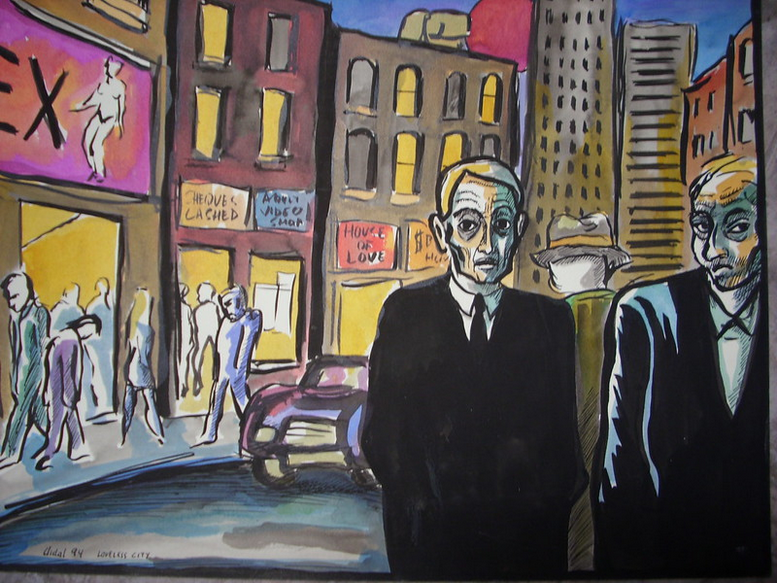
Yet he still enjoyed walking the streets of the ghetto at night. The word ghetto, in the not so far past, had meant a place where people different from the mainstream had been grouped together, within very defined physical boundaries, so that they could be supervised or even kept apart from a more acceptable society. But it was different now. A ghetto now was merely a numbered neighbourhood with its own Office for the Maintenance of Systemic Harmony, where the citizens lived apparently well, but suffered the constant surveillance of the so called Guides. These guides where in fact a sort of police force, but they operated on a new set of beliefs and protocol . The Law was based on a theory which had arisen right after the end of the Third Great War: that every accident and mishap and every negative element affecting the correct course and outcome of any process, arose from an uneducated and uncontrolled interference. Human lack of meticulousness and human tendencies to wanton and impractical thoughts and acts were at the root of all accidents and misfortunes. Everything had to be done according to positive rules and regulations, from the up keeping of the environment, to the management of the weather and, specially, the thoughts, hidden or outwardly expressed, of each individual. There where no longer any visible political leaders or clearly defined structures of power. The System itself was composed of an infinity of grey individuals who dutifully did their jobs and thus procured its impeccable upkeep.
Those who were physically unsound were carefully guarded, given their tendency to morbid emotions and speculative thinking. They all lived in Ifram Blest´s ghetto, which was number 62. It was a hard job the Guides had, keeping the anxious and wondering nature of those who were ill, maintained alive by medication or machines, from causing alterations to the System.
There existed a generalized opinion that those who were infirm in any way should be put to death for the sake of the well being and security of the rest. But the Times of Brutal Inhumanity were still remembered, and such a measure would have defeated the very purpose of the System.
Ghetto 62 was nice enough, a clean place, but a place were people were picked off the streets quite regularly, and subjected to lobotomy more than frequently. It was above all a very quiet neighbourhood where everybody minded what they said to everybody else. No one was rich in the ghetto, yet no one starved. The rich lived in different areas, and they were never seen by the common citizen.
The rejuvenation of cells had become a fact, and it was mandatory for everyone to undergo this procedure every ten years. Ifram Blest himself looked and moved, according to the old standards, like a forty year old man, yet he was almost one hundred and thirty. His mind however was full of such sadness and regret as no person in a former era would have had a chance to know. It had been in a time almost out of memory that people could look up and see an empty sky, and draw a sense of wonder and calm from it. Whenever one observe the sky now, it was crossed by countless flyers. They looked like symbols of fire , almost Biblical in their ominousness and intensity. yet they were mere machines, and the human eye had no rest from them, Nor was there any real darkness because the many lights of the vast cities, which had long connected with one another and taken over most of the world, reflected against the heavens, which was forever a lacteous mother of pearl colour.
As he meandered along the cold, snowed in streets of ghetto 62, Ifram Blest could not help feeling that the luminescence from the sky were actually lights meant to keep him visible to people whom he could not see in return. He tried not to be afraid or irritated, but he would have given anything to be able to walk in real darkness, undefined, himself a shadow.
He walked for a long time without a soul crossing his path. The silence was deafening. And the fact that he could walk for so long without feeling tired or out of breath surprised him considerably. How could someone with end stage kidney failure, whose blood was taken out and put back into his body by a machine in order to be detoxified, feel even remotely like a normal, healthy person? Contrary to general belief, he understood that no disease affects everyone in the same way.
Ifram Blest had always been a very strong individual. And he still was. His energy did not originate in the body alone, and he was secretly aware of this. A sick man, he nevertheless didn´t fit the bill as someone who, without the hemo machine, would have been long dead. Not that he didn´t wish to be, frequently enough. But there was something about his unusual resilience and strength which led him to believe that he had been predestined for some mission. Of course he kept that notion hidden from all, since to harbour it meant that he was a believer in something beyond human order and intentions, which was forbidden and a symptom of madness.
He had no way of knowing what that mission was. The Universe leads us places and seldom lets us know where or why. But one thing he knew: every so often, whe he was undergoing his dialysis session, he felt, among the preternatural, gargling sounds of the machines, as though he had been submerged in amniotic fluid, which caused him a weird stupor, and he would experience a sort of trance. In that trance, he had visions more vivid than any reality. Yet there was nothing phantasmagorical abut them. They were in fact mundane, about things that had happened, or were happening, or would happen at some point.
The ones that had the clarity and logic of real life sequences, often came surrounded by the grotesque and terrifying vestiges of nightmares that were truly dreadful and impossible to explain. He could not tell where the monsters he saw came from. They were perhaps reflections of his own fears, or a bizarre jumble of the many horrible memories gathered by the human brain through its evolution. It didn´t matter. He did not want to analyze his mind, the one instrument which allowed him to recognize that he was a man bent on surviving in the middle of hell. For he could not deny that the world was, had always been hell.
The night was very cold but he was enjoying it. Snow flakes brushed softly against his face like myriad little wings of butterflies of frost. And he felt the beating of his own heart inside his chest. He stopped walking when he was across the street from the behemoth building of the Health Center, a gloomy affair in old style architecture, the only structure remaining in the ghetto which was not glass and aluminum and nonflammable plastic, but brick and wood, with neo-gothic windows and crooked old gables. It was also the highest building around. High-rises had not been built since the end of the last war, when they had been found insecure and the easy targets of areal strikes.
A line of ambulance flyers resembling huge ray fish were parked in front of the building, and the hemodialysis patients of the night shift were coming out of them, helped by medical technicians. Most of them used aluminum canes. A lot of them were missing a part of a leg, amputated because of uncontrollable infection resulting from diabetics. Long term suffering was reflected in their eyes, which had a lost, glazed look. They moved slowly to the entrance of the building, like a long line of ghosts in a dream. The ambulance flyers brought them there and back home every time they underwent treatment. He also was a patient at this building, three times a week, four hours each time. An ambulance flyer also brought him here and back on those occasions, alongside a good number of other hemodialysis patients. He still felt awkward and out of place among them, as if he had not been sick like them, but the victim of a false diagnosis.
Sallow skin.
Chapter 2
A feeling of nausea came over Ifram Blest as he was walking towards the portion of street where the ambulances were parked. Acid lights illuminated a crowd of slow moving, stunned beings who seemed huddled together against the bitterly cold wind. He recognized many of them. They were the night group, ready to enter the red Cross building for their dialysis session. Many of them smoked cigarettes, ate cookies or sucked on candies. They were of all ages, shapes and colours. Leading them along toward the entrance of the building was doctor Eve Lawe.
She was a forty something year old woman whom Blest actually found likeable in more ways than one. She was rather short, with a strong body, a face which was neither pretty nor disagreeable, but rather severe, although intelligent and in a way expressive of a tender humanity. She had straight reddish hair and wore eyeglasses. Of all the doctors he had been forced to deal with since the onset of his disease, she was the only one who didn´t seem stupid or arrogant to him. She didn´t just babble from the authority of her office, but actually listened to patients and endeavoured to communicate. She seemed quite aware of the suffering
Blest was going through, no only physically, but also spiritually. And he had to admit that if it hadn´t been for the fact that he was a sick man and therefore in no position to expect a woman to feel attracted to him, he would have unveiled to her the feelings of desire and warmth which she inspired in him.
As he walked up to her, she gave him a short smile, a slightly ironic look.
Wednesday, January 11, 2012
When people look at him, talk to him, interact with him in any way, Ifram Blest is always surprised to realize that he does not read them at all. Often, he feels that such a lack of comprehension on his part is a result of his illness, which has turned him into an alienated, excessively introspective man. But he knows, on a deeper level, that that isn´t the case.
Children often show naturally that they have a sort of psychic perception of each other´s inner lives and imagination. That is possibly due to the fact that their memories are still vastly unoccupied by recollections of experiences which would make them dissimilar. They are all waiting for life to happen. And, as life happens, their minds begin to dwell on personal interpretations of what occurs to them, and little by little the distance between each other grows, until they become adults, and can no longer see what makes them beings of the same species. But the moment, pleasant or painful or indifferent, is of no import in the end.
The mind of Ifram Blest lingers mostly in eternity. That is to say, while his body deteriorates day after day, imposing myriad symptoms and evidence of ongoing collapse, his mind constantly absents itself from time and flies over a veritable ocean of events, instances and moods that, although faded from immediate reality, constitute the truth of life.
From a window of an apartment high up near the sun, his mother, as she appears in his memory before she grew sick, waves her hand at him, with a beautiful smile on her face. And who cares if his mother, in the end, hadn´t been so good to him? What really matters, will always matter, is that she could smile at him like that. It was the same with everybody else, his father, a long time dead but breathing deeply into his dreams, into his mouth every time he spoke. With his sisters, whom he never saw any more, but who were there in the corners of his world looking at him as he moved into his own immateriality. And the women he had been intimate with. And of course his son, whose eyes contained the calm and fury, and the colours, of a sea of yore. That everyone hailed from that same sea and that the blood inside us flows from and back to it, he knew beyond a doubt. But then, what caused the cold distance, the misunderstanding, the vast nothingness between people?
A frozen morning begins and the city looks hard, and from no where in it comes any sign of warmth or compassion. People begin to fill the streets and go about their routine with a sort of forlorn tenacity. No body really wants to be there, to do what they do. At a little coffee shop, Ifram Blest drinks his first coffee of the day. He reads the news on the small screen in the middle of his table. He must read fast, as the lines appear and disappear quickly. The screen, that particular one, is blue, and the letters are yellow. Everybody inside the café is avoiding to look at anyone else. Exchanging glances is lewd a thing to do. Looking at someone more than fleetingly and aloofly is an invasion of space.
Ifram Blest enjoys a far away memory of the days when people used to smoke and there were drunks in the corners. Now everyone must exercise control over themselves, and physicality in general has to be disguised with the proper behaviour. There is an irony in that, beyond the rigorous manners required of every citizen for the sake of equilibrium and at least superficial harmony, a lot of people like himself are dying silently, of illnesses still as primitive as in the days of old, and of a sadness equally profound and primeval.
And the news are full of horror. He reads that the remains of a murdered man have been found along a stretch of railway tracks, cut in pieces neatly wrapped in plastic and spread at intervals of twenty feet or so from one another.
Ifram Blest feels the beginnings of nausea rising from his guts. But he is hardly surprised, because he knew about this atrocity. Some days before, as he lay half asleep in his dialysis bed, he had had glimpses of a dark figure walking by the railway tracks, in heavy rain, placing those bloody plastic bags on the ground carefully, as if he was concerned with the creation of a geometrical pattern. Of course, he had told the doctor about that vision, or dream, as he was supposed to do with all he experienced while on treatment.
Thursday, January 12, 2012
Although Blest liked her, he didn´t really know what she actually thought of him. Occasionally, while he was in bed getting treated, she would approach and delicately feel his ankles with her fingers. The contact sent a sort of electric wave across his body to his mind. He realized then with some apprehension that the gentle pressure she applied to his ankles was the only touch he had received in years from a woman´s hand. He wondered, in a state of vague confusion, if she felt anything beyond clinical curiosity when she touched him. Was she aware of the emotions he went through, as an ill person prostrated on a hospital bed, as she smoothly checked the lower part of his extremities for possible edemas?. He knew he was strong enough to be able to make love to her, but she probably wasn´t aware of that. She probably assumed he was useless. Her interest in him was of a humiliating sort: she didn´t have the time to regard him as an equal, as a person like herself, but only as a suffering victim whom it was her job to help.
“Your ankles aren´t swollen” she always said,” but your skin is really dry. You should rub some Nivea cream on it occasionally”
Her main concern was to psychologically prepare him for an eventual transplant but she understood that, secretly, he wasn´t keen on the idea of getting a new organ. He was afraid of a possible mistake during the operation, of his body rejecting the graft and having to return to dialysis, twice as sick as before, and terrified of having to take drugs to suppress his immune system for the rest of his life. In a very profound way, he felt that his immune system had always been excellent. He never really caught colds or other infections. And if he cut himself, he would stop bleeding fairly quickly. That they should annul his defences in order to force his body to accept a new kidney, that that twisted form of quid pro quo, was at all necessary if he wanted a chance at survival, seemed to reveal a sadistic streak in the fibre of life itself. It was maddening. And he wasn´t sure that it wasn´t better to accept death than to go through what he saw as a sad and bloody pantomime just to get a chance at a few extra lousy years in a world that had greatly lost its charm for him.
But then there was his child, his little boy whom he saw in dreams every night, and in reveries by day. The hope of being with him again eventually, unlikely as that seemed, prevented him from totally giving up on himself.
“I want to make sure you go into the operating room and free yourself from the machine” said Eve Lawe, looking at his head resting on the pillow as if she were a powerful, beautiful alien speaking to him from above, from a spaceship. And he thought,”I am not a poor sick child, you know? I could make love to you right here and now. It´s probably what I really need.” But she just felt sorry for him. And he said nothing.
Ifram Blest, spectral and thin, wrapped in his long dark coat, walked along the street toward the Red Cross building. Some of the patients recognized him and languidly waved at him. The snow fell in light flakes and it was cold. When Eve Lawe saw him, she went to meet him. She had a look between worried and perplexed.
“It´s not your turn, Ifram” she said “why are you here?”
“I couldn´t sleep, doctor. Just going for a walk”
“They have been calling about you. They want to talk to you.” she told him “
“I thought so. Well, they know where to find me. I can´t very well get too far from the machine, can I?”
“We are putting a lot of effort and money to keep people like you alive. You owe it to the state to respect the protocol” She said.
“I haven´t broken the protocol. I just typed a meaningless question on my computer”
“There are names which we are trying to eradicate from memory. They simply inspire discord. Jack Kerouac is one.”
“I don´t really give a shit about Jack Kerouac, doctor.”
“You tell them that. When you see them. Which you will”
“I don´t care if they unplug me, doctor. It´s all a lie and I´m tired. Even that I am alive is a lie. Not really. I am only half here”
Her eyes were brown, with perhaps the vaguest tinge of green.
“Ifram, your typing that question on your PC is one thing. But they have other reasons for wanting to see you. They have been looking at your case for a while. They know about your visions”
“Why were they told about that?”
“It´s all in the medical records. Of course everything is specified there. And they have found similarities between the descriptions you gave us of what you saw, or dreamed, during dialysis, and the crimes…”
Every one had disappeared into the building and the ambulances were leaving. The street was empty. Eve Lawe began to walk toward the entrance. It was the beginning of the night shift. Ifram Blest would walk around all night long and go back to sleep at daybreak. The sky at times seemed filled with spiralling symbols of fire, but it was only the Flyers. There were no messages from any god.
Original Story / Post by Vidal Alkolea Pulgar, at Blogspot.com between Tuesday, October 25, 2011 to Thursday, January 12, 2012 / Edited by Naccarato on October 6, 2022 / copyright: 2022